GEOTECHNICALENGINEERING
VICTORIA BC
HomeFoundationsPile foundation design

Pile Foundation Design in Victoria BC — Deep Foundations on Vancouver Island Soils

Technical studies that support your project.

LEARN MORE

Across the Greater Victoria area, from the fractured basalt of the Metchosin Formation to the compressible marine silts of the Inner Harbour, pile design decisions are driven by stratigraphy, not rule-of-thumb. Our team has seen too many projects where preliminary SPT values above N=60 in the upper till gave a false sense of security, only for the pre-consolidation pressure of the underlying Victoria Clay to control the settlement calculation. Deep foundations here must account for the transition from dense Vashon till to soft glaciolacustrine deposits, often within the same borehole. This is why we integrate in-situ permeability testing when the pile tip is embedded in a confined aquifer, and pair every design with a liquefaction assessment for the loose sand lenses that appear below the Colwood gravels.

In Victoria’s glacial stratigraphy, the difference between a successful pile design and excessive settlement often lies in 60 cm of missed soft clay within the Vashon till sequence.
Our service areas

Methodology and scope

The contrast between a site on the rocky outcrops of James Bay and one on the deltaic deposits of the Colquitz River floodplain is extreme, and it dictates the entire pile design philosophy. In James Bay, we often design rock-socketed drilled shafts because the glacial till is thin and the bedrock is shallow, requiring careful verification of socket roughness per Wyllie (1999). Near the Colquitz, however, we encounter up to 12 meters of soft organic silt, where driven H-piles or closed-end pipe piles are more suitable to minimize soil displacement. For the intermediate case — the dense Vistula till that covers much of Saanich — we perform CPT testing to capture the continuous sleeve friction profile, which allows us to refine the unit shaft resistance in a material that standard SPT samplers often disturb. The pile design must also respect the City of Victoria’s Subdivision and Development Bylaw, which often triggers a geotechnical peer review when foundation loads exceed 3000 kN.
Pile Foundation Design in Victoria BC — Deep Foundations on Vancouver Island Soils
Technical reference — Victoria BC

Local geotechnical context

We reviewed a 10-story residential tower on Yates Street where the initial design assumed a uniform bearing stratum at 18 meters depth. The reality, revealed by a detailed stratigraphic model, was a paleochannel filled with normally consolidated clay that extended to 26 meters in one corner of the site. If the piles had been terminated at 18 meters, the differential settlement between the corner columns and the core would likely have exceeded 25 mm, cracking the curtain wall system. This scenario is not rare in Victoria — the pre-glacial drainage network is irregular and can create isolated pockets of soft soil that do not appear on regional maps. Our seismic microzonation work indicates that these soft pockets amplify spectral accelerations at periods of 0.5–1.0 seconds, directly affecting the ductility demands on the pile-to-cap connection.

Need a geotechnical assessment?

Reply within 24h.

Email: [email protected]

Regulatory framework

NBCC 2020 (National Building Code of Canada), CSA A23.3-19 (Design of Concrete Structures), CSA S6-19 (Canadian Highway Bridge Design Code), ASTM D4945 (High-Strain Dynamic Testing of Deep Foundations), CFEM (Canadian Foundation Engineering Manual, 4th Edition)

Typical values

ParameterTypical value
Design StandardNBCC 2020, CSA A23.3-19, CSA S6-19
Typical Pile Types in VictoriaDrilled shafts (rock sockets), driven H-piles, closed-end pipe piles, CFA piles
Seismic Design CategoryClass C to E (per NBCC 2020 Table 4.1.8.4)
Lateral Load Analysisp-y curves (API RP 2A / Reese & Van Impe)
Settlement Analysis MethodT-z curves, Vesic elastic solution, or finite element
Typical Socket Length in Bedrock1.5 to 3.0 m (Metamorphic/Granitic rock)
Dynamic TestingPDA and CAPWAP per ASTM D4945

Questions and answers

What is the typical cost range for a pile foundation design in Victoria?

For a standard residential or light commercial project in the Capital Regional District, the geotechnical investigation and pile design typically range between CA$2,490 and CA$9,360, depending on the number of boreholes, the depth of exploration, and the complexity of the structural loads.

How does the NBCC 2020 seismic hazard affect pile design in Victoria?

Victoria is in a high seismic hazard zone. NBCC 2020 requires site-specific ground motion analysis for Site Class E and F soils. Pile design must consider kinematic soil-pile interaction, potential liquefaction of the sand layers, and the ductility of the connections. We use the spectral accelerations from the NRCan Seismic Hazard Tool for the specific coordinates of the site.

When is a rock-socketed pile necessary versus a friction pile in Victoria?

A rock socket is necessary when the overburden is thin or contains soft clay layers that cannot provide adequate skin friction, a common condition near the shoreline in Victoria West and parts of Oak Bay. Friction piles are often feasible in the thick Vashon till deposits of Saanich and Langford, provided the settlement analysis confirms the performance is acceptable under the design loads.

What testing do you perform to confirm the pile capacity after installation?

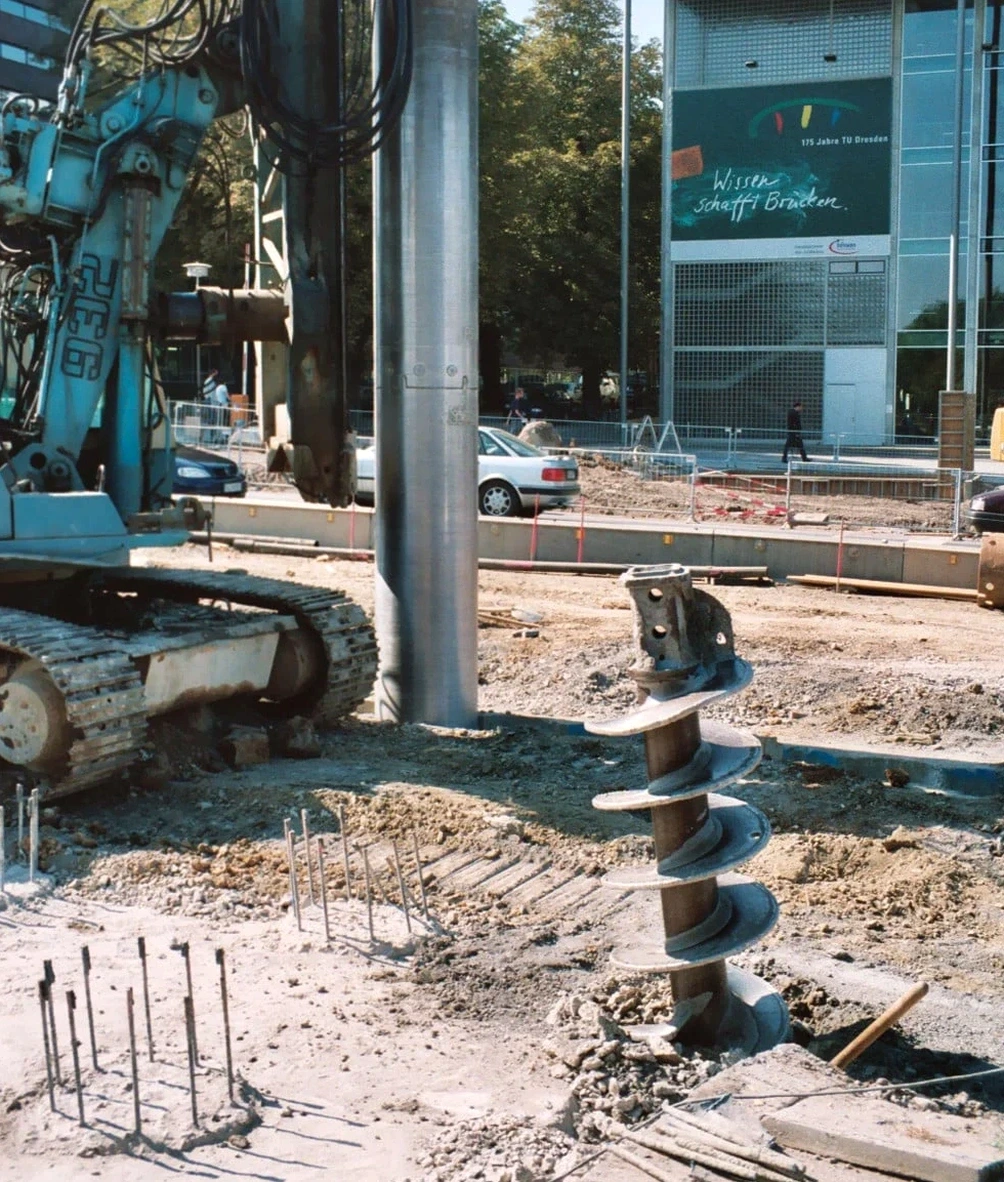
We perform Pile Driving Analysis (PDA) with a Pile Dynamic Analyzer during driving for driven piles, and we can also supervise static load tests (compression, tension, or lateral) for drilled shafts. For critical structures, we may recommend cross-hole sonic logging (CSL) to verify the integrity of the concrete in drilled shafts.

Location and service area

We serve projects in Victoria BC and surrounding areas.

View larger map