GEOTECHNICALENGINEERING
VICTORIA BC
HomeIn-Situ TestingField density test (sand cone method)

Field Density Testing in Victoria BC — Sand Cone Method for Site Compaction

Technical studies that support your project.

LEARN MORE

You can feel the difference just walking a site. Fairfield's dense, overconsolidated glacial till is nothing like the soft marine silts of James Bay. In Victoria BC, that contrast isn't academic — it's what decides whether a trench backfill passes or fails. A test pit log from Oak Bay tells one story; a hand auger sample from Vic West tells another. The field density test (sand cone method) bridges that gap. We use it to verify compaction on everything from residential footings in Gordon Head to sewer line reinstatement in downtown Victoria. It's the direct, low-tech check that still beats nuclear gauge reliability when you're working near services or buried utilities. When the City of Victoria inspector walks onto your site, we want the proctor curve and the sand cone report to match first time.

Compaction isn't a number on a report. It's the reason a pavement doesn't settle two winters later.
Our service areas

Methodology and scope

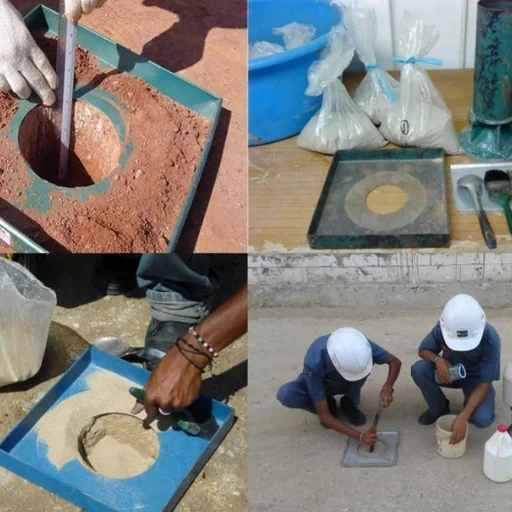
Victoria's winter rain cycle changes everything. A subgrade that hit 98% standard proctor in August can slip to 92% after a November storm. The sand cone test tracks that shift in real time, on real material. We excavate a shallow hole at the lift surface, run the Ottawa sand through the cone, and weigh the replacement volume. The math is immediate: wet density, dry density, compaction percentage against the lab proctor. On Vancouver Island's glacial tills — often gap-graded with cobbles — we sometimes pair the test with a grain size analysis to confirm fines content hasn't skewed the moisture-density relationship. For deeper fills, a plate load test provides the modulus confirmation that density alone can't deliver. The method follows CSA A23.3 compaction requirements for structural fill, with results typically turned around within 24 hours of the field visit.
Field Density Testing in Victoria BC — Sand Cone Method for Site Compaction
Technical reference — Victoria BC

Local geotechnical context

Victoria sits at 23 metres above sea level on average, but it's the seismic reality — the Leech River fault runs 5 km south of the city — that sharpens the conversation about compaction. Loose fill amplifies ground motion. After a 6.5 magnitude event, a poorly compacted utility trench becomes a linear failure path through a subdivision. The field density test is the last physical verification before pavement or slab covers the fill. There's no second chance. We routinely test lifts at 300 mm intervals for structural fill under retaining walls along the Gorge Waterway, where differential settlement can crack a wall within a single wet season. The sand cone method is slow compared to a nuclear gauge, but it's immune to density anomalies from buried services — a non-issue in Victoria's older neighbourhoods with undocumented infrastructure.

Need a geotechnical assessment?

Reply within 24h.

Email: [email protected]

Regulatory framework

CSA A23.3 — Concrete structures (compaction of structural fill under slabs), ASTM D1556 — Standard Test Method for Density of Soil in Place by the Sand-Cone Method, ASTM D698 / D1557 — Standard/Modified Proctor, BC Building Code 2024 — Part 4, structural backfill requirements

Typical values

ParameterTypical value
Test standardASTM D1556 / CSA A23.3 reference
Hole diameter150–200 mm typical
Sand typeGraded Ottawa sand (20–30 uniform)
Depth rangeLift thickness (150–300 mm typical)
Result metric% of Lab Proctor max dry density
Report turnaround24 hours standard
Moisture contentField sample by ASTM D2216

Questions and answers

How many sand cone tests do I need per lift?

Typically one test per 300 m² of lift area, or one per lot on residential subdivisions. The City of Victoria may specify tighter spacing for utility trenches — often one test per 50 linear metres of trench. We review the spec with you before mobilizing.

What's the cost of a field density test in Victoria?

Budget CA$120 to CA$180 per test depending on site access, number of tests on the same day, and whether we're providing the proctor curve from our own lab. Mobilization to the Gulf Islands carries an additional trip charge.

Can the sand cone test be used in wet weather?

Yes, with precautions. The Ottawa sand must remain dry — we use a covered balance area. The hole excavation is trickier in saturated soil, but it's doable. We run a moisture content sample alongside every test to correct for field conditions.

How does the sand cone method compare to the nuclear gauge?

The sand cone is slower — maybe 20 minutes per test versus 5 with a gauge — but it's a direct volume measurement. No radiation license required. No density errors from pipes or rebar near the gauge. In Victoria's tight urban lots, the sand cone avoids the regulatory paperwork of nuclear sources.

What proctor do you reference for the compaction percentage?

We run the standard proctor (ASTM D698) or modified proctor (ASTM D1557) depending on the project spec. Most Victoria structural fill calls for modified proctor at 95% minimum. We can run the proctor on your borrow material or use the project's existing curve.

Location and service area

We serve projects in Victoria BC and surrounding areas.

View larger map