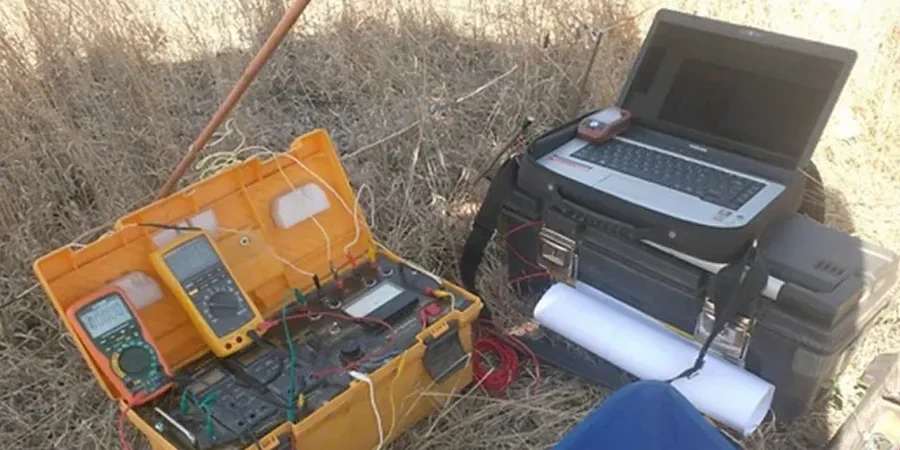
A four-electrode array stretches across a glaciated slope in Saanich—stainless steel stakes driven into damp till, a resistivity meter clicking through programmed measurement cycles. That's a typical field setup for a Vertical Electrical Sounding campaign in Victoria, where the Cordilleran ice sheet left behind a complicated layering of till, marine clay, and outwash. The instrument injects a controlled DC or low-frequency AC current through the outer electrodes while the inner pair measures the resulting potential difference; the ratio yields apparent resistivity, and as electrode spacing expands, current penetrates deeper. In Victoria's post-glacial terrain—think the Victoria Clay beneath James Bay or coarse outwash gravels near UVic—the method separates conductive silts from resistive bedrock without a single drill hole. The resistivity curve is then inverted with software that accounts for the city's characteristic three- and four-layer models.
When borehole control is available nearby, we tie the VES interpretation to lithology logs for calibrated depth-to-bedrock maps. Our field crew has run these lines from Langford to Oak Bay and knows how the local geology—and urban stray currents—affect data quality.
A single VES sounding in Victoria can distinguish between dry granular outwash and saturated marine clay before a shovel breaks ground—that's the value of non-invasive resistivity profiling in post-glacial terrain.