GEOTECHNICALENGINEERING
VICTORIA BC
HomeInvestigationExploratory test pit

Exploratory Test Pits in Victoria BC: What You Miss When You Skip the Dig

Technical studies that support your project.

LEARN MORE

The biggest mistake we see in Victoria BC is a contractor ordering a full geotechnical report based only on boreholes, then hitting a buried concrete vault in James Bay or a perched water table in the Uplands. The core barrel spins. The hole collapses. The schedule blows out. An exploratory test pit would have caught it. Our crew digs to 4.2 metres in a standard day on accessible lots, logging stratigraphy in real time. We sample directly from the bucket or from the wall face. No waiting for lab results to know there is a problem. For sites near the harbour where fill is deep and unpredictable, we often combine the pit program with spt-drilling to get blow counts below the reach of the excavator, giving you a continuous profile from surface to refusal without blind spots.

If the excavator bucket hits refusal at 1.2 metres, you know the footing design just changed. No guesswork, no delay.
Our service areas

Methodology and scope

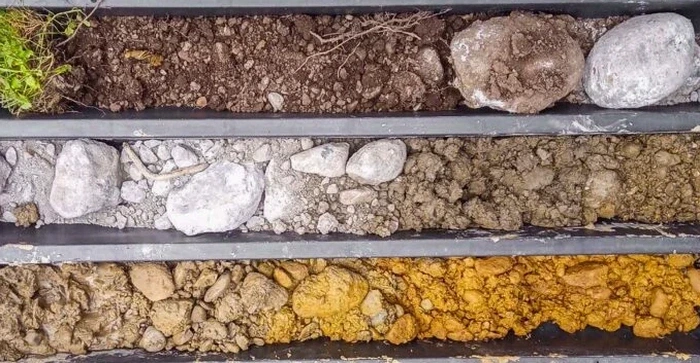
Victoria BC soil changes fast. A lot in Fairfield sits on Quadra Sand, well-drained and predictable. Half a kilometre north in Fernwood, you hit the Victoria Clay layer, sticky grey material that holds water for weeks after rain. The exploratory test pit lets you see the transition with your own eyes. We log colour, moisture, consistency, and any organics or fill debris. The excavator bucket exposes the contact between native till and overlying fill, which is critical for footing depth decisions. We also measure groundwater seepage directly from the pit wall, a number no desktop study can give you. Our field lead photographs every lift and notes any odours, staining, or buried obstructions. The log is signed off same-day. Municipal inspectors in Victoria BC accept our pit logs for foundation depth verification and for soil classification per the NBCC site class table.
Exploratory Test Pits in Victoria BC: What You Miss When You Skip the Dig
Technical reference — Victoria BC

Local geotechnical context

The 2011 Christchurch earthquakes taught geotechnical engineers a hard lesson about hidden paleochannels. Victoria BC sits in a similar seismic setting, CSZ subduction events and shallow crustal faults capable of a magnitude 7 scenario. A test pit is the simplest way to rule out liquefiable sand lenses within 4 metres of the surface. When we dig in low-lying areas near the Gorge Waterway, we check for loose saturated sands that could trigger a bearing failure under seismic load. The NBCC 2020 site classification demands evidence, not assumptions. A pit wall exposes the stratigraphy plainly. You document it, photograph it, and move forward with a defensible Site Class. For critical structures, we pair the pit observations with masw shear wave velocity profiles to confirm the Vs30 value matches the logged soil type, closing the loop between visual observation and dynamic soil property.

Need a geotechnical assessment?

Reply within 24h.

Email: [email protected]

Explanatory video

Regulatory framework

NBCC 2020 (National Building Code of Canada, seismic site classification), ASTM D2488 (Standard Practice for Description and Identification of Soils, visual-manual procedure), CSA A23.3 (Concrete structures, referenced for foundation subgrade assessment), Municipal bylaw (City of Victoria soil deposit and excavation permit requirements)

Typical values

ParameterTypical value
Maximum excavation depth4.2 m with standard trackhoe (deeper with stepped benching)
Standard bucket width450 mm to 600 mm trenching bucket
Logging standardASTM D2488 (visual-manual) with Munsell colour notation
Groundwater observationSeepage rate and stabilized level recorded within 24 h
Sampling methodBucket grab samples, block samples from wall face, Shelby tube from pit floor
Typical duration on site2 to 4 pits per day depending on access and depth
Backfill protocolLift-compacted native soil with bentonite plug at surface per municipal spec

Questions and answers

How much does an exploratory test pit cost in Victoria BC?

For a standard program of two to three pits on an accessible residential lot, budget between CA$770 and CA$1,140. The final number depends on access width, depth, and whether we need a spotter for buried utilities.

Do I need a city permit to dig a test pit on my Victoria property?

In most cases, yes. The City of Victoria requires a soil deposit and excavation permit if you are digging deeper than 0.6 metres or stockpiling spoils on the boulevard. We handle the permit drawing submission as part of our scope, showing pit locations on the survey plan.

How soon can you schedule a test pit after I call?

Typical lead time is three to five business days. We coordinate the excavator, the locates technician, and our field engineer. If you have a tight foundation pour deadline, call us. We keep a couple of morning slots open each week for urgent pit inspections.

Can a test pit replace a borehole for my NBCC site classification?

It can, if the pit reaches the required depth and exposes undisturbed native soil. For Site Class C or D determinations, a 3.5-metre pit with logged stratigraphy and shear wave velocity correlation is often sufficient. For deeper profiles or Site Class E, we combine the pit with SPT drilling to satisfy the NBCC 2020 requirements.

Location and service area

We serve projects in Victoria BC and surrounding areas.

View larger map